Day in the Life of the Hudson River Training
by Christina Tobitsch - CURB Director of Education
(photo by Rebecca Houser, NYS DEC)
On September 20, CURB hosted 24 teachers for a special professional development opportunity co-organized by NYS Department of Environmental Conservation and Lamont-Doherty Earth Observatory. Teachers received a crash course in Hudson River Estuary ecology and chemistry to help prepare them for leading a day of field study known as Day in the Life of the Hudson and Harbor. DITL (as it is abbreviated) is an annual October event where hundreds of schools and environmental education organizations across the Hudson River Watershed head out to water’s edge for river exploration and data collection. In a single day, sampling occurs at over 90 sites ranging from the river’s start in the Adirondack Mountains all the way down to the New York Harbor. Data is submitted, pooled, and analyzed to help provide a comprehensive “snapshot” of the river.
So what did teachers learn in their training? Attendees were introduced to different components of DITL study: the physical river, the chemical river, and the biotic river. Traveling through stations throughout the day, teachers were taught how to use a variety of scientific tools for field study.
To understand the physical river, observations were conducted on the river's physical surroundings, tide level, currents speed, and weather conditions. Analyzing the river bottom can also uncover a wealth of information about site conditions. By using a sediment core, we collect a deep sample of the river's many layers of deposited mud, sand, and silt and inspect it for clues to the river’s history and changes over time.
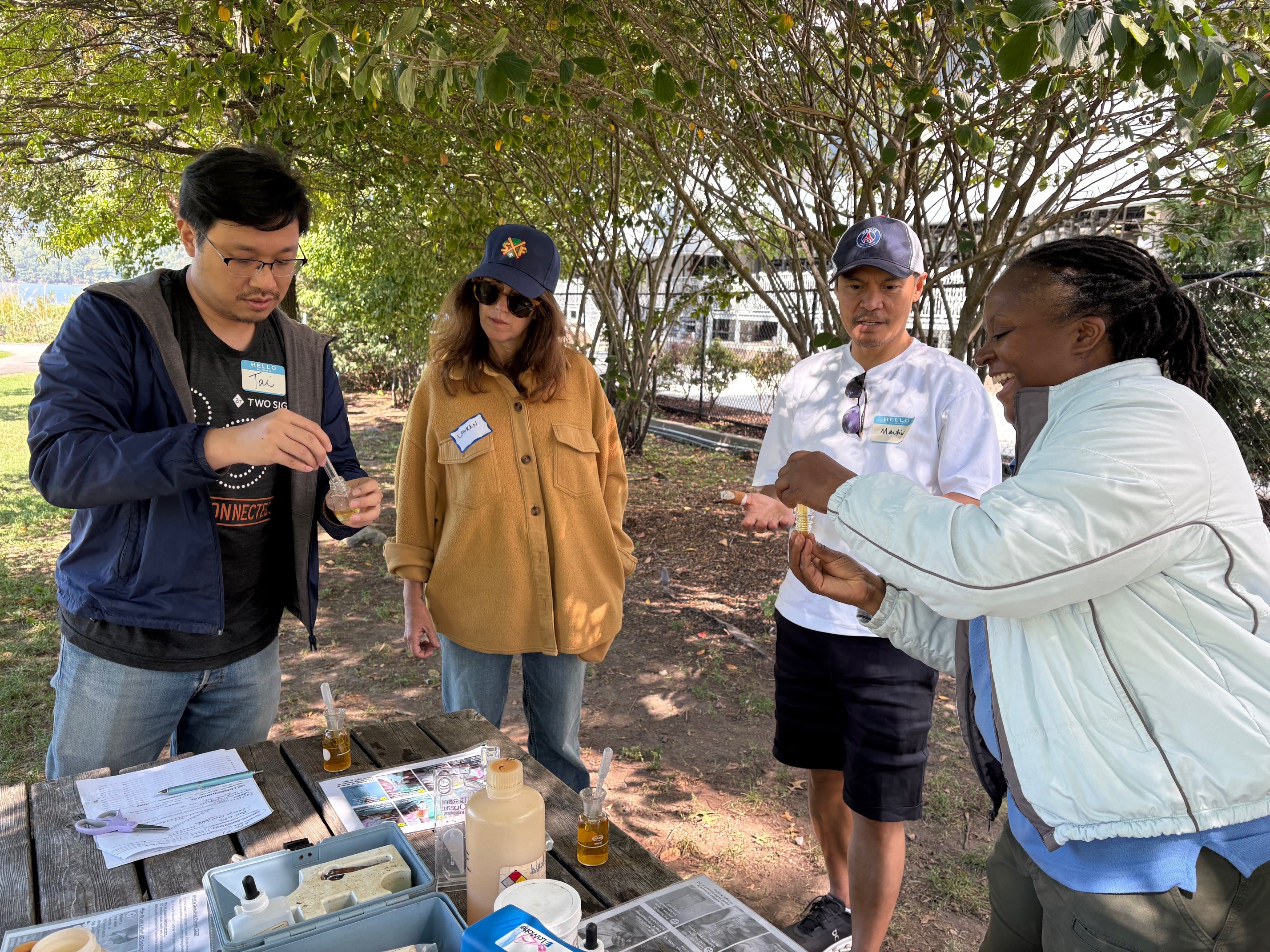
Teachers also learned how to perform several water chemistry tests that help us to understand water quality and other natural conditions of the water. Temperature, salinity, pH, dissolved oxygen, and turbidity of the water can fluctuate in estuaries. Some of these changes are natural and seasonal, but oftentimes the Hudson River’s water chemistry is influenced by human activity. Students are encouraged to not just perform these tests, but hypothesize or further investigate any factors that may have influenced their test results.
Getting a further snapshot of the river’s health can come from conducting a sampling of river species through methods of fishing or trapping. Most commonly, teachers and students will opt to fish by using a seine net. Over 200 species of fish have been identified in the Hudson River.